'On the small island of Bequia in the eastern
Caribbean, one of the islands constituting the country of St Vincent
and the Grenadines, Cullum & Nightingale’s beach house
is a lesson in the reinterpretation of vernacular construction with
an environmental conscience.
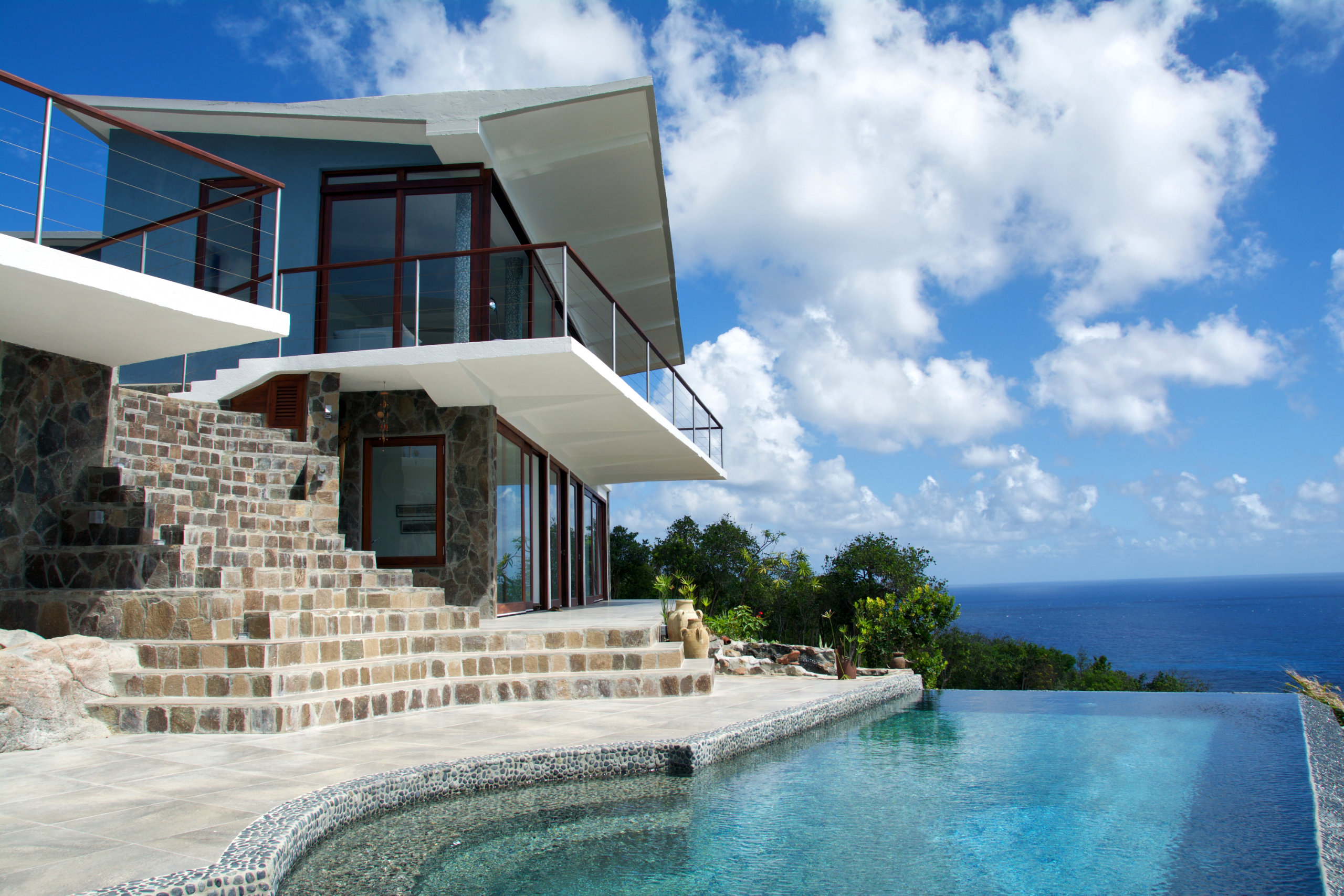
'The house, set amid a coconut palm grove on the edge of a beach,
is designed to blend into the landscape. It forgoes the strong cuboid
form of conventional properties, instead being split into two wings
around an open connecting stairway. This performs the multiple functions
of breaking up the building’s outline, allowing views through
it, and providing maximum exposure to the cooling breeze.
'Natural ventilation is capitalized upon in every living space.
Large areas of seaward-facing walls throughout the house feature
sliding screens - some glazed, some mesh - to encourage a through-flow
of air. However, while the house attracted local attention for its
form, the materials used are all familiar. Sourced from St Vincent
and Trinidad, such elements as the monopitch corrugated roofs are
a mainstay of Caribbean buildings, as is the extensive use of timber:
greenheart here, because this dense wood fares better than metal
in the harsh coastal atmosphere.
'As Bequia does not have running water, rainwater is collected
from the roofs and stored in a large tank dug into the hillside.
Water is heated using solar panels, and after use in the house it
is reused to irrigate the garden.
'The property makes subtle reference to its Caribbean location
in many ways, from hints of the bright colours that are apparent
everywhere, to casts of palm fronds in the concrete ceilings. Essentially
though, Cullum & Nightingale’s house bows to the beauty
of its environment, and for that reason it is truly successful.'
Caption Notes:
- New Eden House is situated at the foot of a steeply graded site
that also includes the original colonial-styled Eden House. However,
the new property borrows from local architectural tradition, rather
than importing English style.
- The new addition to the site is a multilayered exercise in semi-open
spaces and verandas. A bridge and drawbridge allow access to upper
levels that sit within but not above the existing foliage.
- The numerous overlapping single-pitch corrugated roofs drain
into a large tank, collecting rainwater for use around the property
as there is no mains supply on the island.
- While New Eden is virtually on the beach, it does not encroach
on the idyllic scene: the house’s unique design breaks up
its outline and helps it to blend with the natural surroundings.
- All rooms are open to the elements. The architect refused to
use environmentally detrimental air conditioning, and so cooling
breezes off the ocean must be allowed to percolate through the
property to regulate the temperature.
- The house is built within and around nature. Great care has
been taken to integrate it into its island setting, rather than
imposing a new element upon the pristine surroundings.
- Splashes of colour hint at Grenadian architectural tradition.
This is also true of the corrugated steel of the roofs and the
extensive use of local timber.
- The property is split into two three-storey towers, linked by
external landings. A bridge provides access to the second-floor
bedroom and veranda. On the first floor are two more bedrooms,
while at ground level are the kitchen, the dining and living rooms,
and an outdoor terrace.
|