|
'Faced with the need to accommodate more readers and books and to improve access, Emmanuel College chose to extend its 1970s extension. Architects Kilburn Nightingale suggested a thick re-cladding. Jeremy Lander considers the outcome.
'Emmanuel College library is a fascinating example of how
a building complex can change and grow organically -
like a hermit crab finding a new shell when it needs more
space, or like a mollusc that grows by adding layer upon
layer.
'From 1673 the library was housed in the old chapel
which became vacant when Christopher Wren's new
chapel was completed. In 1931 it moved to the 1909
lecture-room building designed by Leonard Stokes that
overlooks the wonderful lawns and pond at the southern
end of the site. The red brick and stone building was
converted and extended by one third, almost seamlessly,
by Stokes' younger partner George Drysdale. In the early
1970s the library began to outgrow the Stokes building
and architects Cruikshank Seward designed an extension
attached to the south-west corner [B]. It was a singularly
drab building with chamfered corners, expressed
concrete floor slabs and panels of brick similar to the
adjacent 1966 South Court by Tom Hancock, but without
any of its charm.
'Since then the library has grown and grown (the death
of the book having been announced prematurely) and
from about 2001 the College began thinking about another
extension. It commissioned a number of feasibility studies
to establish and test the brief - to provide at least 60 new
reader spaces, additional rare book and archive storage,
better access for wheelchair users and greater
environmental controls as both the rare book collections
on the ground floor of the Stokes building and the 1970s
building suffered badly from solar gain and lack of
insulation.
'It's a wrap!
The main thrust of the brief was to re-use the Cruikshank
building rather than re-build it. Re-use was seen as a cost-effective
and environmentally sustainable approach.
Phasing would also be easier as alternative
accommodation for book storage would not be needed
during construction and, despite its shortcomings, the
Cruikshank building was a very efficient book store with
low floor to floor heights crammed with shelves. However,
lack of reader spaces meant users had to trek back and
forth between it and the reading room in the Stokes
building, negotiating tricky level changes. Opening up the
1970s building to provide new reader spaces and
improving the connection between the two was crucial to
any new design.
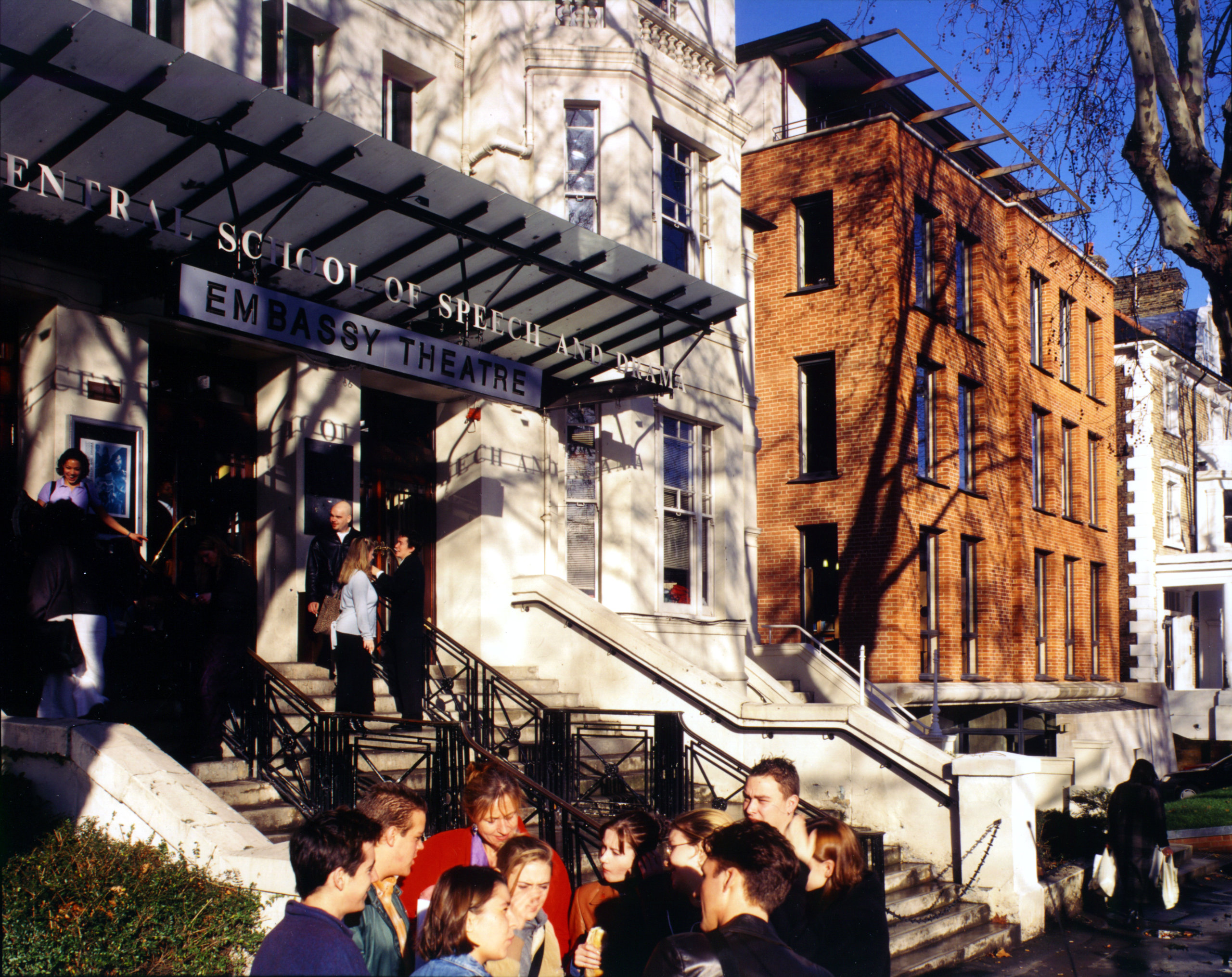
'When a competition was held in 2005 it was won by
the London practice of Kilburn and Nightingale (formerly
Cullum & Nightingale) ; they had built relatively few
libraries but had the classy red-brick Central School of
Speech and Drama library in their portfolio and were
working at Corpus Christi on rehousing the world renowned
Parker Library. They convinced the College
with a clever refinement of the re-cladding idea,
wrapping the 1970s building in a layer thick enough to
house the additional reader spaces. They then fitted the
remaining additional accommodation neatly between the
Stokes building and the ancient wall that marks the
historic southern boundary of the College [5 and 10].
'The decision to reuse and recycle seems a sensible
one but it is interesting to imagine what future generations
might make of it. In the past libraries have been moved or
entirely rebuilt - why cling on so tightly to the 1970s
skeleton? If it saved a little on time and budget how
important was this when colleges measure their projects in
terms of centuries? It is certainly interesting to contrast the
different approaches over the years: 1673 and 1909 - let's
move; 1931 - let's make the extension appear exactly the
same; 1970s - let's make the extension an appendage;
and 2011, let's bond the appendage more closely to the
host building yet make it strikingly different by cladding it
with timber.
Clever, complex and cosy
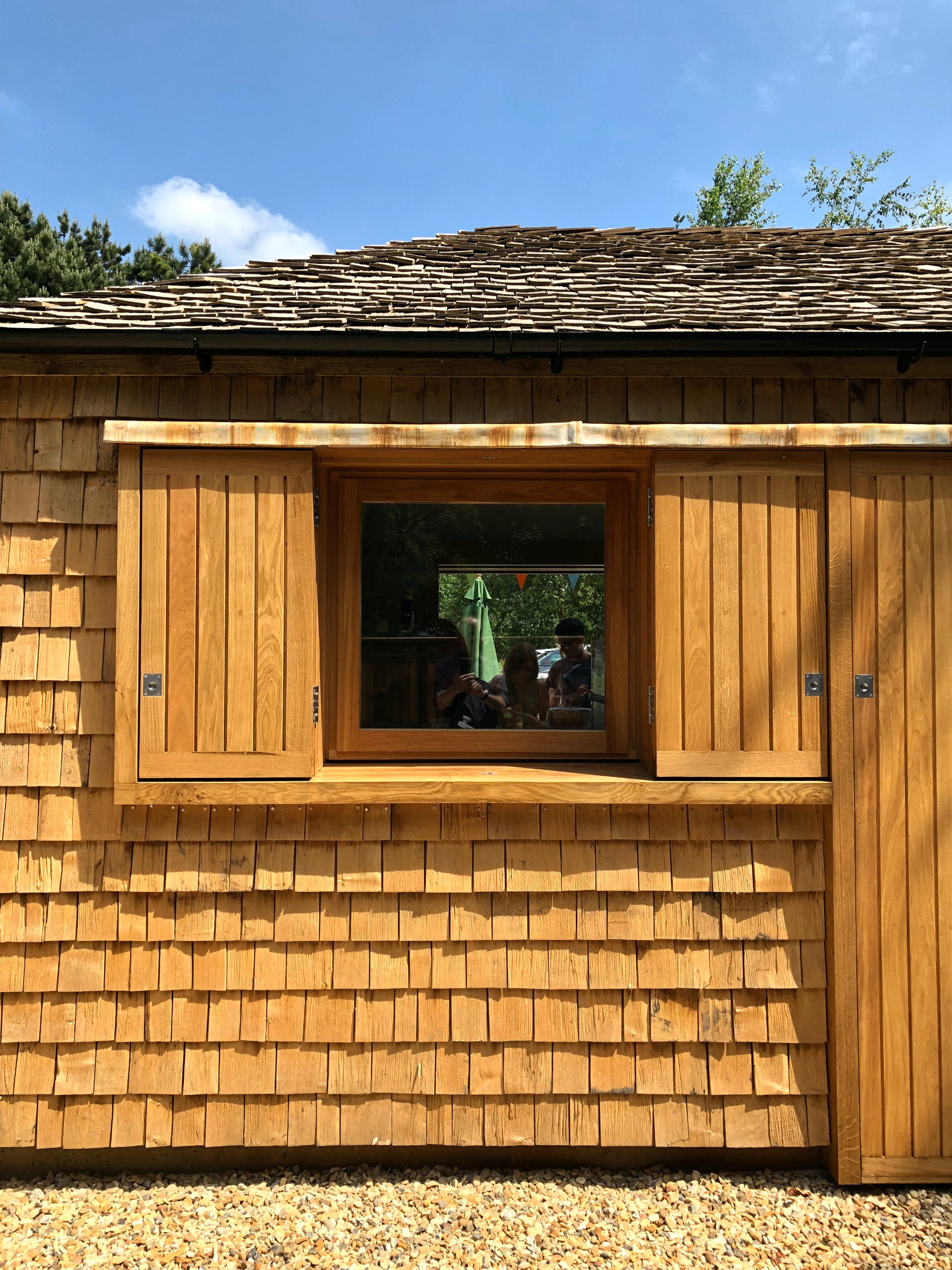
Timber is the material of our time and in Emmanuel's new
library we have it in abundance, in this case as vertical
'board on board' sweet chestnut, a locally-sourced and
sustainable timber which is left untreated [3]. The cladding
ripples around all of the new envelope, folding into fins on
the south and west side (these resemble the spines of
books) and between these are vertical windows of stained
and etched glass [9] providing a contrast to the earthiness
of the chestnut and an opportunity to display benefactors'
names. They also cleverly steer views away from the
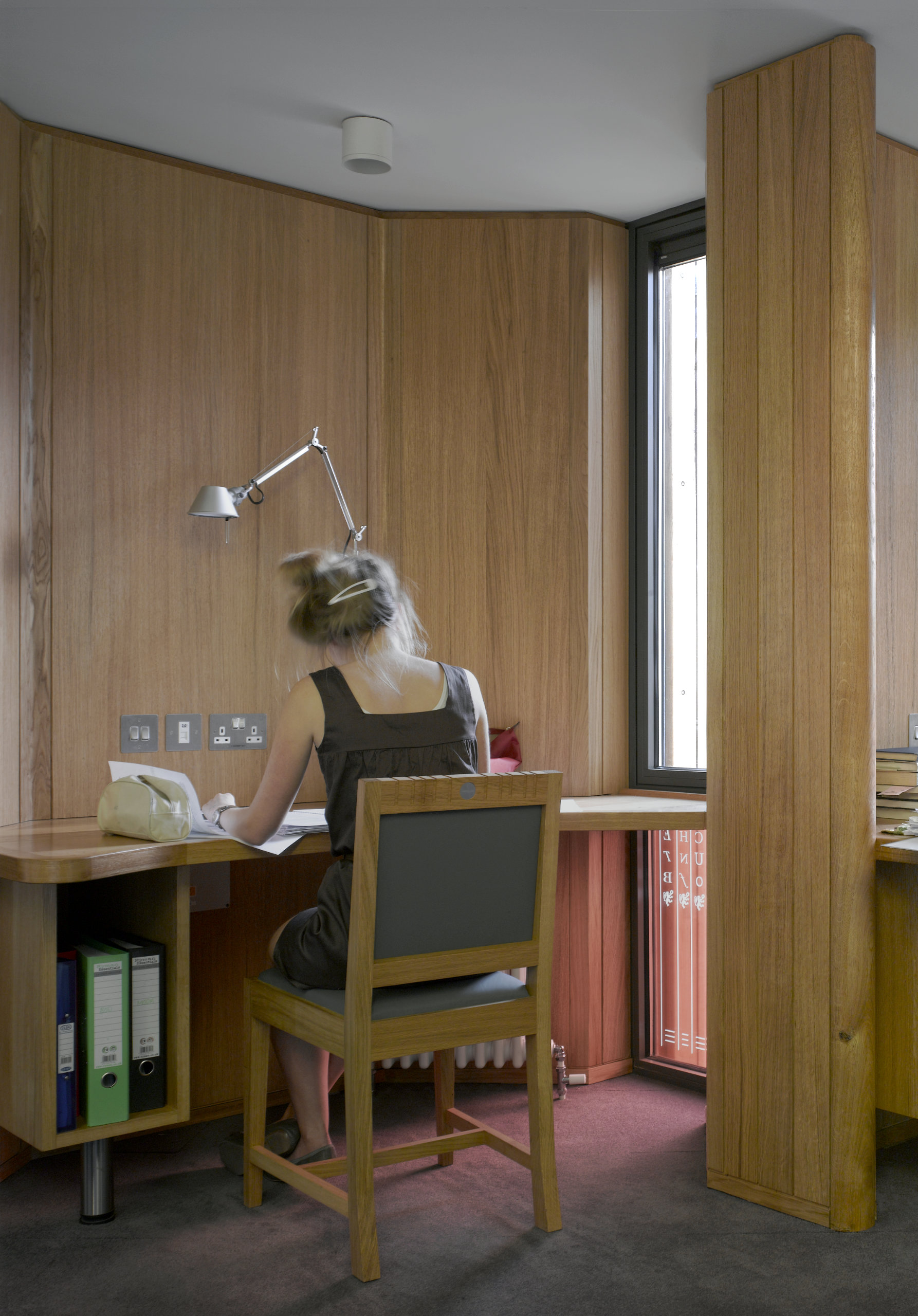
nearby bedrooms of South Court and create individual
reader spaces which are cosy without feeling
claustrophobic [1]; you can really imagine finding your
favourite space and settling down to work with just the
right level of distraction. The wrapping is made to work
hard too - services travel up and down within the pochés
created by the beautifully detailed oak joinery.
'On the top of the Cruikshank building is a new reading
room [2]. This is an elegant space with round rooflights
and wonderful views over the rooftops but externally the
opportunity to express it as a true 'attic' storey with
different surface treatment was not taken, instead there is
more chestnut cladding. This is a pity as the concept of the
chestnut as a wrapping loses some of its purity.
'The new entrance and reception area is a delightfully
rich and complex space with an angled view to the walled
garden through an atrium which, with its chestnut brise
soleil, forms an environmental buffer to the Stokes
building. The 1909 mahogany staircase was reconfigured
to lead off the new reception and at first floor, where
before there was a tiny glass umbilical link, there is now a
wonderfully flowing space with views towards Parker's
Piece. A Common Room looks back across a green roof
planted with meadow flowers that extends the idea of the
garden up through the new building. The refurbished
Stokes interior provides a sumptuous foil for the white
walls and crisp joinery of the extension but it is interesting,
and not surprising, that the 1970s were not thought to be
worth celebrating at all, the only sign being a slightly
incongruous staircase. As with most transplants the donor
organ is vital but invisible.'
Jeremy Lander is a partner in Freeland Rees Roberts, architects.
|